

(I’ve made all three - more than once)
I used to walk into networking events thinking I was prepared. I had a clean elevator pitch. I knew what I was “looking for.” I even rehearsed how I’d introduce myself on the subway ride over.
And yet, I kept walking out of rooms with a pocket full of business cards and nothing actually changed.
No real follow-ups.
No meaningful conversations.
No opportunities that moved the needle.
It took years of attending (and now hosting) startup events to realize something uncomfortable:
Networking doesn’t fail because people don’t try, it fails because people try the wrong way.
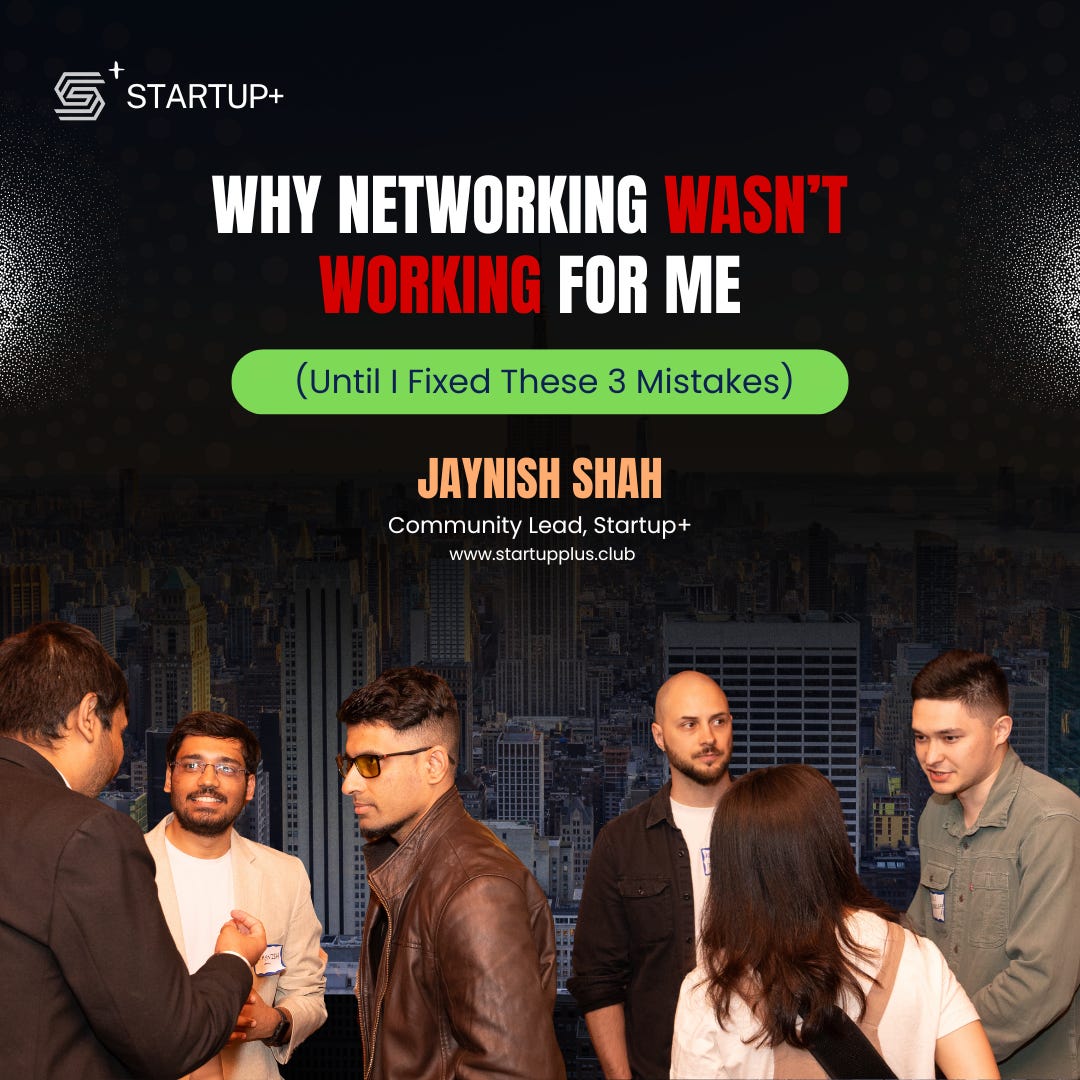
Here are the three biggest networking mistakes I made & see others make every single week.
❌ Mistake #1: Treating Networking Like Pitching
Early on, I thought networking meant explaining myself well.
So I led with my startup, my role, my idea, my ambition, sometimes within the first 30 seconds 🎤.
I’d walk up to someone and immediately switch into pitch mode.
What I didn’t realize was how fast this puts people on defense.
At one event, I remember introducing myself to an investor and launching straight into what I was building. He nodded politely, glanced around the room, and within two minutes said, “Nice meeting you, enjoy the event.”
That moment stuck with me.
Later, I realized the issue wasn’t the idea, it was the timing.
Networking conversations aren’t pitches.
They’re pattern-matching exercises.
People are subconsciously asking: Do I enjoy talking to this person? Do I trust them? Do I want to continue this conversation later?
When you lead with a pitch, you skip all of that.
I wrote more about this shift in mindset in “The Right (and Wrong) Way to Investor Pitch”, because pitching has a place, but that place is rarely the first five minutes of a casual conversation.
The breakthrough for me was learning to start with curiosity instead of explanation. Conversations got longer. People leaned in.
And follow-ups started happening naturally.
❌ Mistake #2: Using Generic, Forgettable Openers
For a long time, my go-to opener was some version of:
“So… what do you do?”
It felt safe. Polite. Normal.
It was also completely forgettable.
At one Startup+ mixer, I realized I had asked the same question to five different people, and received five nearly identical answers. Worse, I couldn’t remember who said what ten minutes later.
That’s when it clicked: the opening line sets the entire energy of the conversation.
I started experimenting. Instead of default questions, I tried more specific, human openers. Sometimes about why they came. Sometimes about what they were building right now. Sometimes about what they were curious about lately.
The difference was immediate.
People relaxed. Stories came out. Conversations stopped feeling transactional.
I eventually distilled this into a simple idea that became “The One Line That Works at Any NYC Networking Event” not a magic sentence, but a mindset shift away from robotic small talk
Networking doesn’t reward cleverness. It rewards presence.
❌ Mistake #3: Leading With Need Instead of Context
This one took me the longest to unlearn. - Seriously!!
I used to introduce myself by what I was looking for:
“I’m looking for a job”
“I’m raising”
“I’m looking for investors”
“I’m looking for customers”
I thought I was being honest and efficient.
In reality, I was forcing the other person to immediately decide whether they could help me which is a heavy ask five minutes into meeting someone.
At one event, I distinctly remember watching someone’s body language shift the moment I said, “I’m looking for opportunities.” The conversation didn’t end abruptly, but it quietly lost momentum.
Later, after reflecting (and talking to others), I realized something important:
People help when they understand you, not when you pressure them.
This insight led me to write “Stop Saying ‘I’m Looking for a Job”, because framing yourself around need shrinks the conversation instead of opening it
The fix was simple but powerful:
Lead with what you’re exploring, not what you want.
Why Most Networking Advice Doesn’t Work
Most networking advice focuses on tactics — how to pitch, how to follow up, how to “optimize” conversations.
But networking is not a hack. It’s a human system.
That’s why so much generic advice fails in real rooms with real people. I broke this down more deeply in “Why Most Networking Advice Is Useless”, because context always beats scripts.
The best connections I’ve made didn’t come from perfect lines or clever strategies. They came from showing up consistently, listening well, and letting conversations evolve naturally.
✔️ The real goal of networking (that no one tells you)
The goal of networking is not to:
❌ collect contacts
❌ pitch your startup
❌ ask for favors
The real goal is much simpler:
Leave the conversation in a way that makes continuing it feel obvious.
That’s it.
If someone walks away thinking, “I’d like to talk to this person again,” you’ve won. 🎖️
Everything else comes later.
Final thought
Every strong relationship I have today started as an ordinary conversation in a noisy room. No pitch. No agenda. Just presence and curiosity.
If networking has ever felt awkward, forced, or ineffective, you’re not doing it wrong. You’re just learning.
I’ve been there. I still am.
Let’s continue the conversation
If this resonated, or if you’ve made some of these mistakes yourself, I’d genuinely love to hear your story.
👉 DM me on LinkedIn: Jaynish Shah (www.linkedin.com/in/shahjaynish/) or send me an email on jaynish.shah@startupplus.club
See you at the next Startup+ mixer on February 5 (Thursday). RSVP now.